Roots Run Deep
Having descended from Finnish immigrants who landed in Gogebic and Houghton Counties in the early 1900s, Jonene Eliasson and Roger Hewlett were no strangers to Michigan Tech despite...
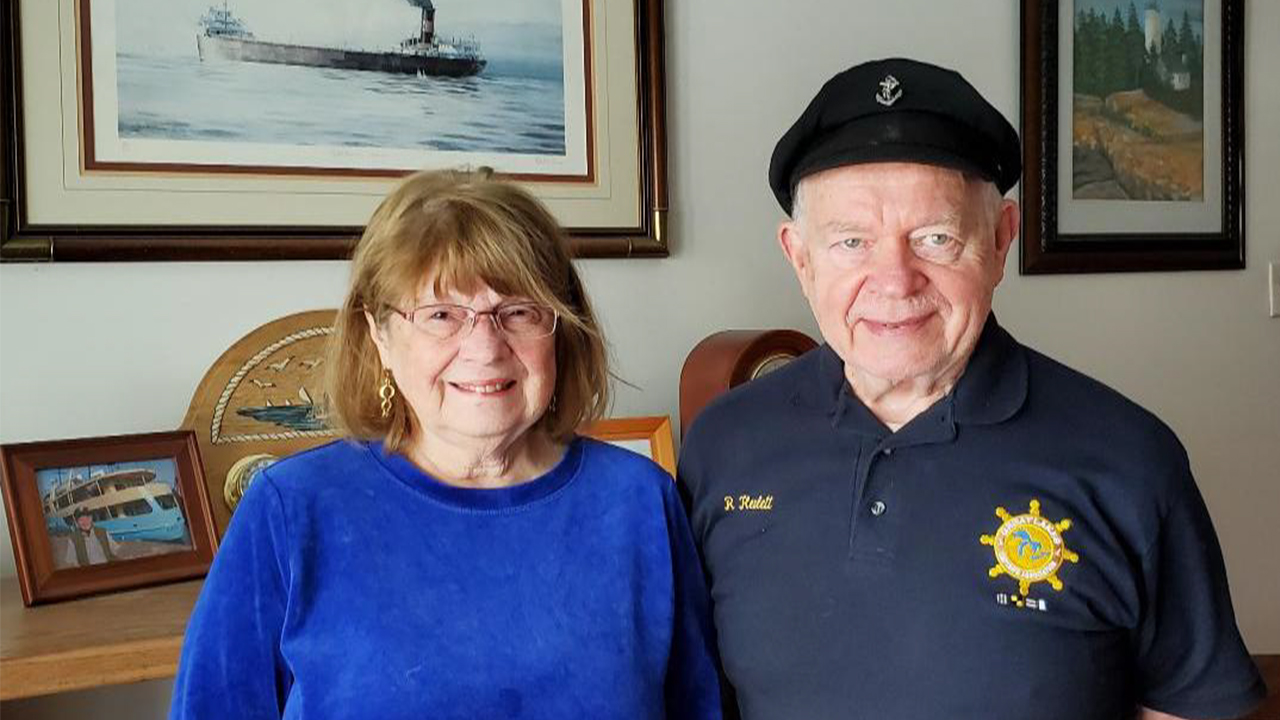
Having descended from Finnish immigrants who landed in Gogebic and Houghton Counties in the early 1900s, Jonene Eliasson and Roger Hewlett were no strangers to Michigan Tech despite both growing up in Detroit. While neither graduated from the University, they are both choosing to make a difference in students lives through their gifts.
Eliasson and Hewlett were married in 2004, shortly after they each retired and more than 50 years after they both attended Cody High School. They moved to St. Clair, Michigan, where they still reside today, in addition to spending summers in the Keweenaw.
A Brothers Impact
Eliasson was born in Bessemer, Michigan, but spent her childhood in Detroit alongside her older brother, Brian. While their parents did not attend college, they instilled a strong love of learning in their children, which led to Jonene and Brian becoming first-generation college students. She attended the University of Michigan (U of M) to earn her bachelors degree in French, and Brian went to Michigan Tech to study physics. He graduated with his bachelors degree in 1959.
Brian always wanted to go to Michigan Tech, she said. I think its because our parents valued quality education. Since we were originally from the UP, he chose Michigan Tech because it was a return to his roots.
After graduating with honors from Tech, Brian went on to graduate school at the University of Pittsburgh. He worked for the US Patent Office in Washington, DC, the University of Michigan, and Consumers Energy. After his professional career came to a close, Brian wrote poetry to fulfill his life. He passed away in 2003 at the age of 66.
Inspired by the impact that Michigan Tech had on her brother Brian, and by the influence Brian had in her life, Eliasson established the Brian Lee Eliasson Annual Scholarship through an estate gift. The scholarship will be awarded to students who are majoring in physics.
I realize how important it is for students to have financial support nowadays, even for families that have means, she said. This scholarship is a way for me to say thank you to my brother. Its a way to say thank you to Michigan Tech for giving him an education.
In addition to a degree from U of M, Eliasson studied at the University of Paris, the University of Alaska, and Middlebury College. She taught high school and junior college French, and worked at the University of Michigan Health System for many years until she retired.
A Curious Spirit Leads to Lifelong Support of Michigan Tech
An adventurous and curious kid, Hewlett grew up with an urge to explore, sharing a story about the time he hopped on a Greyhound to Ohio from Detroit at the age of 10, just because he could. That endless curiosity manifested itself in his career path.
Hewlett had tunnel vision for what his future would look like when he graduated high school. I was going to do one thing in life: sail on ships until the day I die, he said. From 1956 through 1964, Hewlett worked on Merchant Marine ships on the Great Lakes and oceans sailing around the world. Fortunately, with a little coaching from shipmates, I became wiser, he said. Eventually, he decided that he would go to college and pursue a mechanical engineering degree.
He graduated from Wayne State University in 1965taking classes during the semester and, by drawing from his marine experience and contacts, earning money sailing on ships worldwide during the summers.
After graduating, his new career led him to positions at the Detroit Diesel Division of General Motors while simultaneously obtaining a masters degree in mechanical engineering through night classes at Wayne State.
In time, he found himself performing engineering field tests on crewboats in the Gulf of Mexico, tugs in Portland, Oregon, oil rigs in Alaskas Arctic, and mining equipment in copper mines of Zambia in Africa. In 1970, Detroit Diesel promoted him to regional engineer covering the southeastern US and later, assistant to chief engineer of Detroit Diesel of Brazil Operations, living in Brazil for four years. In 1978, he transitioned himself to GMs affiliated Isuzu Diesel Engine Operations in Farmington Hills, and also taught night school engineering classes at Lawrence Institute of Technology.
Liking the academic aspect, in 1987, he embarked on a new adventure and quit his occupational and social existence and moved to Houghton to enroll as a post graduate student at Michigan Tech. Im the type of person that, no matter how good things are, I get itchy feet, he said. I thought of how much I would like to live in the Copper Country, in the Keweenaw, and go to Michigan Tech. So thats what I did.
Hewlett attended Tech for about two years, until an opportunity came up to go back to the open waters. He became captain and tow boat operator for Isle Royale National Park for six years, then retired as captain of a survey vessel for the Army Corps of Engineers in Sault Ste. Marie, Michigan, and eventually went back to Detroit Diesel as a contracting engineer. He officially retired in 2003, but for the past 20 years, he has continued to take advantage of opportunities that allow him to get out on the water on Great Lakes towboats as well as assistant engineer on the Houghton based Ranger IIIa passenger vessel for Isle Royale National Park in the Keweenaw.
Hewlett has always been an avid skier and skied many of the mountains of Austria, Switzerland, and South America, and owned a condo in a ski village in Alaska for 20 years. He also learned to play accordion during his tenure in Houghton and plays with a group for dances. Presently, he puts on presentations with ships, mines, and railroads as the topics.
When asked how Michigan Tech impacted him, Hewlett noted the community, his family ties to the region, and the reputation of the University, in addition to inspiration from professors Bill Predebon, Charles Van Karsen, and Johnny Johnson.
It is a highly-renowned University, he said. But along with that comes everything that I love: Lake Superior, the Keweenaw, the land, the forest, the snow trails, the mines, the Copper Range history, and the ships that come and go. All of that goes together to make me feel like Im at home.
His dual career in engineering and sailing, in addition to his education from Michigan Tech, resulted in Hewlett supporting the Great Lakes Research Center and the Department of Mechanical and Aerospace Engineering through yearly donations and a charitable gift annuity.
I thought, instead of keeping my money in the bank, I will let it be with Michigan Tech and earn the income, he explained. Its in Michigan Techs command, but Im also reaping some benefits. I think its important for people to realize that youre probably going to die with money in the bank. It might as well be designated to a good cause, and you still earn income on it through the charitable gift annuity.
Eliasson added, Leaving money to a great University you get the satisfaction of knowing that your money is going to be well spent. Scholarships enable many Tech students to pursue their educational dreams.
While education is arguably the most important thing that Michigan Tech offers, anyone in the community knows how deep its roots runeven for those who may not have received a degree.
Michigan Tech was important for my brother, but we still are a part of the community, Eliasson said. We go to the Rozsa Center for performances, and weve both used the Tech Archives, where I was able to get a copy of my grandfathers naturalization papers when he became an American citizen.
They also shared that Hewlett owned a couple student rental houses and enjoyed renting them to students coming from Finland. One of his student renters was Pasi Lautala, who is now a professor in the Department of Civil, Environmental, and Geospatial Engineering.
The connections never end, shared Eliasson. It is wonderful and so important, especially with great universities. You feel proud to be associated with them.